Introduction #
Every watch collection has an origin point, and for Chanel, that point is the Première. Launched in October 1987, it was the house’s first entry into watchmaking, a decision that surprised an industry still dominated by masculine, round-cased designs. Chanel didn’t try to fit into horology’s existing rules. Instead, the brand built a watch around its own visual language, drawing on Paris architecture and its most famous perfume bottle rather than anything borrowed from traditional watchmaking codes.
Nearly four decades later, the Première still shows up on secondary markets with steady demand, particularly among buyers who want something with real design pedigree rather than just a logo. For anyone shopping pre-owned, the appeal is straightforward: it’s a genuinely historic piece that also happens to be one of the more approachable ways into Chanel horology, price-wise. But because it’s been in production for so long, in so many material and movement variations, buying one confidently means knowing what you’re looking at, and knowing how to tell an authentic piece from a well-made fake.
This guide walks through the Première’s design story, its technical evolution, three pre-owned pieces worth considering, and the practical authentication checks that matter most when buying secondhand.
The Design Story Behind the Première #
The Première’s octagonal case wasn’t a stylistic flourish, it was a direct architectural reference. Chanel’s design team looked at the Place Vendôme, the Parisian square housing the brand’s original boutique, from above. The square’s faceted, geometric layout became the case shape. It’s a subtle piece of storytelling: the watch case is, quite literally, a miniature map of the ground Chanel was built on.
The second reference point is more sensory than architectural. The case’s angled silhouette echoes the stopper on the N°5 perfume bottle, the house’s most recognizable object outside of its handbags. Putting that shape on a wrist watch tied two of Chanel’s flagship products together decades before “cross-category branding” became a marketing term.
Then there’s the chain. The Première’s bracelet, whether in metal-only links or metal woven through leather, isn’t incidental either. It’s the same chain logic used on the Classic Flap bag’s shoulder strap, and it appears across other Chanel leather goods too. For anyone who already owns a Classic Flap or has studied Chanel’s hardware, the Première’s bracelet will feel immediately familiar. That’s intentional. Chanel wanted a watch that read as unmistakably “Chanel” even without a visible logo, and the chain does a lot of that work.
From First Watch to Haute Horlogerie: The Première’s Evolution #
The Première launched as a quartz watch, and quartz versions remain the most common on the pre-owned market today. For nearly 30 years, that’s what the collection was: a design-forward quartz piece rather than a mechanical one.
That changed in 2016, when Chanel introduced Calibre 1, its first in-house Haute Horlogerie movement. It was a meaningful shift for the brand’s watchmaking credibility. Building a proprietary mechanical movement is a different level of investment than sourcing quartz modules, and it signaled that Chanel wanted to be taken seriously as a manufacture, not just a fashion house that also made watches.
A year later, for the Première’s 30th anniversary in 2017, Chanel released a second in-house movement alongside an update to the collection that brought in Coco Chanel’s favorite flower, the camellia, as a design motif. This is worth knowing as a buyer because it created a genuine split in the lineup: earlier quartz Premières, and later pieces built around Calibre movements. They’re priced differently and appeal to different buyers, which we’ll get into further down.
It’s also worth putting the Première in context of what came after it. The J12, Boy·Friend, and Code Coco collections all followed, each pushing Chanel further into serious watchmaking, ceramic cases, and mechanical complications. None of them exist without the Première proving, first, that a fashion house could design a watch with real staying power. If you’re comparing where to start a Chanel watch collection, the Première is the historically logical entry point.
Three Chanel Première Watches We Love #
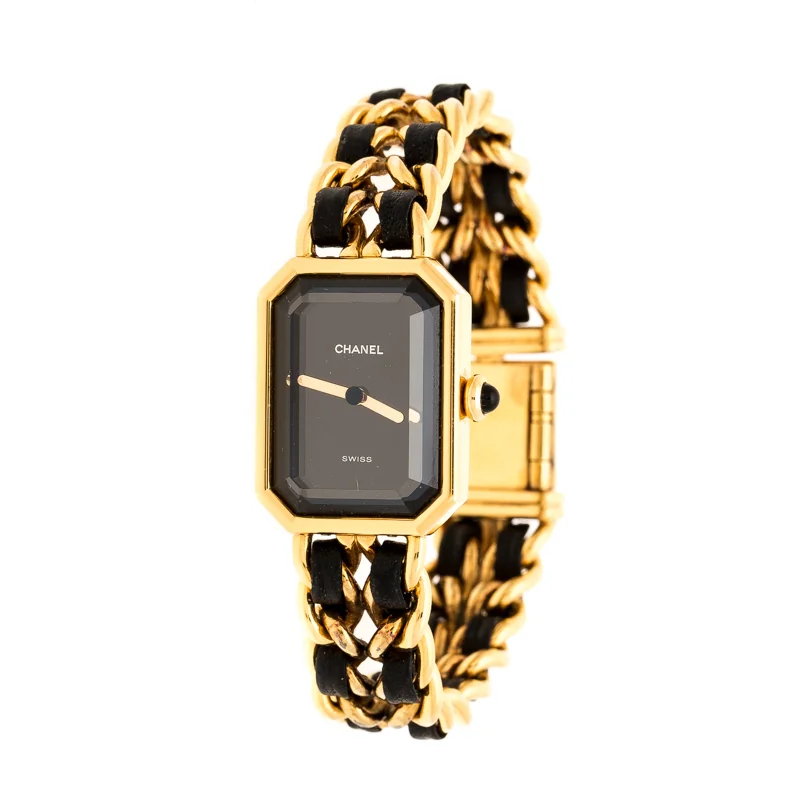
Gold Plated Stainless Steel Première, 20mm. This is the most accessible entry into the collection. Built in gold-plated stainless steel, it runs on quartz and uses two leather-woven chains for the bracelet rather than solid metal links, which keeps the overall weight lighter on the wrist. The black dial is stripped down: no hour markers, just the “CHANEL” and “SWISS” text and a pair of rounded-tip hands. It’s a good option for someone who wants the octagonal silhouette without a heavy price tag.
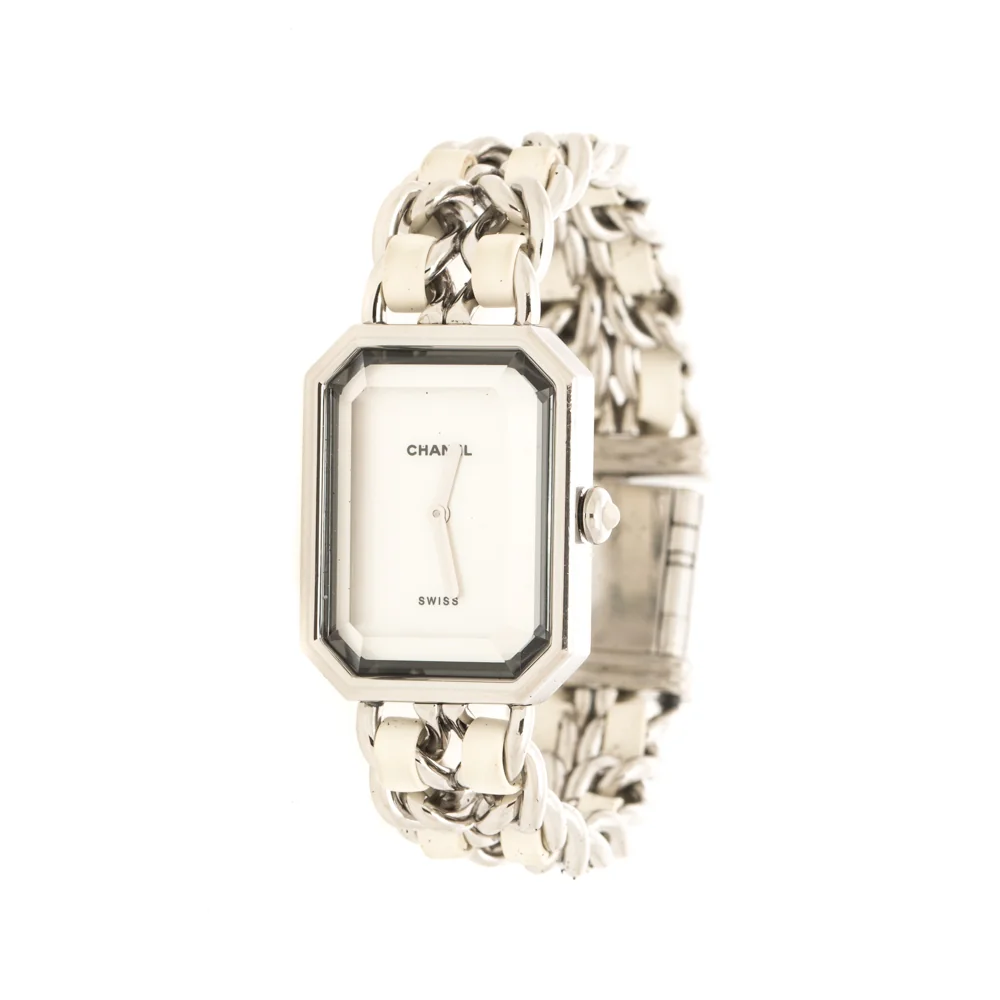
Stainless Steel Première H1639, 20mm. A quieter, dressier take. The dial is mother-of-pearl with steel indicators, which gives it a soft shimmer that changes depending on the light, a detail that photographs beautifully but is hard to fully appreciate until you see it in person. The chain bracelet is looped through white leather, which softens the overall look compared to an all-metal version.
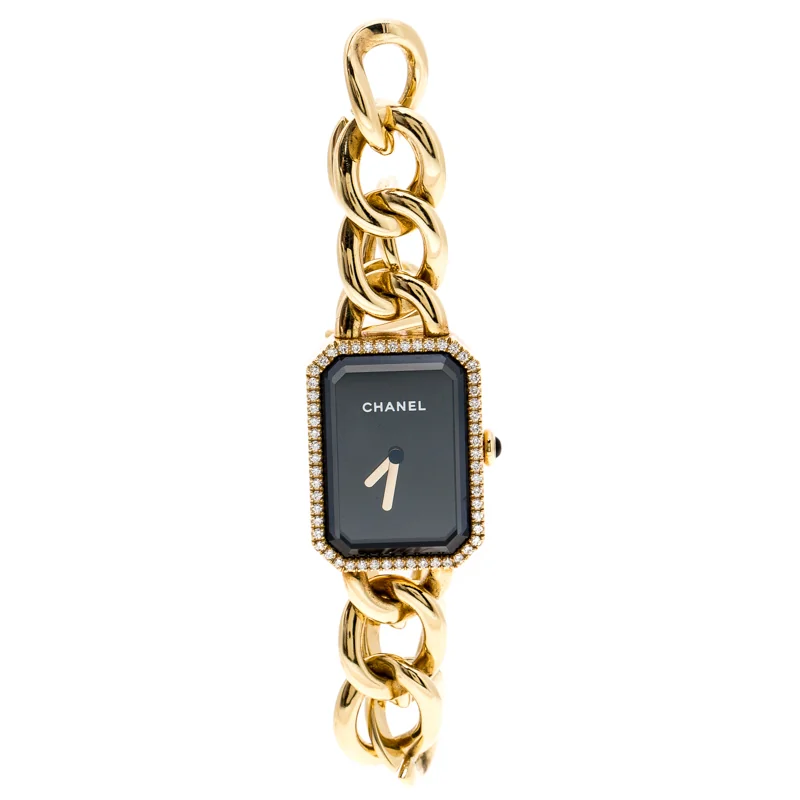
18K Yellow Gold Première Chaîne, 20mm. This one sits at the other end of the spectrum. It’s solid 18K yellow gold with 56 diamonds set into the bezel, and the chain bracelet runs without any leather insert, so it’s metal-on-metal throughout. It functions as much as fine jewelry as it does a timepiece, and pricing reflects that; expect this tier to trade well above the steel and gold-plated versions on the resale market.
Looking at these three together makes the collection’s range obvious. The same case shape and chain DNA carry through everything, but material choice (plated steel, mother-of-pearl and steel, solid gold with diamonds) changes both the personality of the watch and where it lands price-wise.
How to Authenticate a Pre-Owned Chanel Première #
Counterfeits of the Première exist, and because the design relies on a distinctive case and chain rather than an obvious logo, some fakes can look convincing from a distance. A few checks matter more than others when you’re evaluating a pre-owned piece.
Case engravings. Authentic Premières have crisp, evenly spaced engravings on the case back, typically including “CHANEL,” a serial or reference number, and material markings (like “750” for 18K gold pieces). Shallow, uneven, or oddly spaced engraving is a common tell on counterfeits, since replicating laser-precision engraving is expensive to fake well.
Movement markings. If the watch is quartz, open the case back (or ask a jeweler to) and check that the movement is Swiss-made, consistent with “SWISS” printed on the dial. On Calibre 1 or Calibre 2 pieces post-2016, the movement should show Chanel’s own branding, not a generic aftermarket module. A quartz movement inside a watch marketed as Haute Horlogerie is an immediate red flag.
Chain construction. This is one of the more overlooked checks. Genuine Première chains have a specific weight and articulation, links sit flush and move smoothly, and leather-woven versions use consistent, tight weaving with no visible glue or fraying. Counterfeit chains often feel lighter, hollow, or slightly stiff because the link tolerances are looser.
Dial print quality. Text on the dial, “CHANEL,” “SWISS,” or “SWISS MADE,” should be sharp under magnification with no bleeding, smudging, or inconsistent font weight. Genuine Chanel dials are printed with tight quality control; blurred or slightly misaligned text is one of the easiest counterfeit indicators to spot once you know to look for it.
Buy from sellers who authenticate. For pre-owned purchases specifically, buying through a platform or dealer with an in-house authentication process adds a layer of verification you can’t fully replicate yourself from photos. It’s not a substitute for knowing what to look for, but it meaningfully reduces risk on a purchase in this price range.
Buying Advice: Choosing the Right Première for You #
The first real decision is quartz versus Haute Horlogerie. Quartz Premières, generally the pre-2016 pieces and continuing steel/gold-plated models, are more affordable, lower-maintenance, and easier to find pre-owned. They’re the practical choice if you want the design without paying a premium for mechanical movement. Calibre 1 and Calibre 2 pieces, by contrast, appeal to buyers who care about in-house mechanical engineering and are willing to pay more for it, both at retail and on resale.
Material is the second lever, and it maps fairly directly to price tier:
- Gold-plated stainless steel: the entry point. Lighter on the wallet, still carries the full design language, but plating can show wear over years of daily use, so check case edges closely on pre-owned pieces.
- Solid stainless steel with mother-of-pearl or lacquered dials: a step up in perceived value and durability, without moving into precious metal pricing.
- 18K gold (with or without diamonds): the top tier, priced closer to fine jewelry than to a typical watch, and holds value well if condition and documentation are strong.
On [[resale value](/brands/celine-luggage-tote-guide-sizes-history-resale-value/)](/prices-and-value/luxury-price-hikes-2026-resale-impact/) trends: quartz steel Premières tend to trade in a fairly stable, moderate range, driven mostly by condition and completeness (box, papers, extra links). Gold and diamond-set pieces have shown more resilience in holding value, largely because the material cost sets a price floor regardless of the watch market’s mood. Haute Horlogerie Calibre pieces are still a relatively young segment on the resale market, so pricing there is less established and can move more depending on collector interest.
Condition grading matters more here than with a lot of contemporary watches, simply because Premières span nearly 40 years of production. Check the chain for stretch or loose links, the case for plating loss, and the dial for any moisture or discoloration around the edges. A well-kept 1990s piece can still be an excellent buy; a neglected one, even at a lower price, often costs more in servicing than the savings justify.
Design Anatomy: Why the Octagonal Case Matters #
It’s worth sitting with the octagonal case a bit longer, because it’s the single detail that makes the Première recognizable at a glance, and it’s doing more design work than it gets credit for.
Round watch cases are the default for a reason: they’re easier to manufacture consistently, easier to fit standard movements into, and read as “watch” without any further explanation. Choosing an eight-sided case instead meant Chanel’s engineers had to solve problems round cases don’t have, keeping proportions balanced across eight distinct facets, making sure the case sits flat and comfortable on the wrist despite the angles, and aligning the dial and crystal precisely within an irregular shape. None of that is trivial, and it’s part of why early Première production runs are genuinely well-regarded from a construction standpoint, not just a design one.
The symbolism layered onto that shape is what gives it staying power. An aerial view of the Place Vendôme is not an obvious reference point for a watch case, most people wearing one probably don’t know it, but that’s arguably the point. Chanel wasn’t designing a watch that needed to explain itself. It was designing an object that carried the house’s history quietly, for people who already knew the references, while still working as a striking, wearable shape for people who didn’t.
Compare that to how most fashion-house watches from the same era look, largely round, largely interchangeable with whatever the broader watch market was doing. The Première’s case is one of the few examples from that period that still looks distinct, and arguably ahead, decades later. That’s the strongest case for its design significance: it didn’t age into being “vintage,” it was simply early to a shape other brands eventually caught up to.
Première Collection Breakdown: Rock, Electro, Camélia and More #
The Première name covers more variation than most buyers expect, which is why comparing sub-lines matters before you commit to one.
Première Classic. The original silhouette and closest to the 1987 design: octagonal case, chain bracelet (metal or leather-woven), quartz movement. This is the version most commonly found pre-owned and the best reference point for understanding the collection’s DNA.
Première Chaîne. A dressier variation with a fully metal chain bracelet, no leather insert, often in precious metal and sometimes set with diamonds on the bezel. This sits at the higher end of the range and functions closer to jewelry, as seen in the 18K gold piece covered above.
Première Rock. A sportier reinterpretation, typically pairing the signature case with a more casual, often black-toned strap or bracelet treatment aimed at a younger, everyday-wear customer rather than the dressier Chaîne buyer.
Première Electro. A bolder, more graphic take on the line, generally featuring stronger color contrasts and a more architectural presentation of the octagonal case, aimed at buyers who want the Première’s shape with a more contemporary finish.
Première Camélia. Introduced around the 30th-anniversary update in 2017, this version brings Coco Chanel’s signature camellia flower into the dial or case detailing, aligning with the same period that introduced Chanel’s second in-house movement.
On sizing, most Premières run in a compact 20mm case width, which is worth knowing if you’re used to larger contemporary watches, it wears smaller and more delicate than the visual impact of the design might suggest in photos. Some Chaîne and jewelry-forward pieces run slightly larger to accommodate diamond setting, so checking exact case dimensions against your wrist size before buying pre-owned is a reasonable extra step, since resizing a chain bracelet isn’t always straightforward or cheap.
FAQ #
Is the Chanel Première a good first luxury watch? It’s a strong choice if you want a fashion-house watch with genuine design history rather than just brand recognition. Quartz steel versions are also relatively low-maintenance for a first luxury purchase.
How can I tell a quartz Première from a Haute Horlogerie one? Check the movement through the case back and cross-reference with the dial text and reference number. Post-2016 Calibre pieces will show Chanel’s own movement branding, not a generic quartz module.
Does the leather in the chain bracelet wear out? Yes, leather-woven chains can show fraying or dryness over decades of wear. It’s a normal condition point to check on pre-owned pieces and factor into price negotiation.
Are Première watches a good investment? Solid gold and diamond-set pieces have generally held value well due to material cost. Quartz steel pieces are more stable than appreciating, better thought of as a design purchase than a speculative one.
Related Articles #
- Chanel 19 Bag Guide: History, Prices & Buying Tips
- Replica vs Pre-Owned Bags: Which Is the Smarter Buy?
- How to Spot a Fake Chanel Flap Bag: Authentication Guide
- How Pre-Owned Luxury Fashion Is Reshaping the Industry
- Chanel 2.55 History, Details & How to Spot a Fake
Related guides
- Online Bag Authentication: What Photos Can and Cannot Prove
- Inside a Million-Dollar Closet: Pre-Loved Hermès & More
- Meet Marwa Azzam Aldabbagh: Kelly Bag Authentication Expert
- Luxury Handbag Authentication Process Explained
- How to Buy an Authentic Luxury Bag from China Safely
- New vs Pre-Owned Luxury Bags: Which Route Is Right for You?
- Chanel Bag Guide: What to Know Before You Buy
- Luxury Bag Houses


Keyword index