Introduction: The Ethereal Allure of Dior #

Say the name Christian Dior and an image forms before you’ve finished the sentence: a cinched waist, a full skirt, a woman in gray flannel walking into a room like she owns it. Few fashion houses carry that kind of instant, wordless recognition. Fewer still have survived eight decades, six creative directors, and a founder’s death just ten years into the business, and come out the other side more culturally relevant than when they started.
What makes Dior special isn’t a single handbag or a single dress. It’s the specific combination of a founder who rebuilt an entire silhouette from scratch, a house that kept reinventing itself without losing its center, and a product line — from the Bar Jacket to the Lady Dior to J’adore — that collectors and everyday buyers still chase decades after its debut. This piece walks through that history, the design language that survived every regime change at the top, and the practical side too: what these pieces cost today, how their resale value compares to Chanel and Saint Laurent, and what to check before you buy one secondhand.
Christian Dior’s Journey: From Passion to Fashion Empire #
Christian Dior didn’t set out to be a couturier. His family, wealthy from a fertilizer business, pushed him toward diplomacy, and he dutifully studied political science at Sciences Po in Paris. He never practiced it. Instead, in his twenties, he opened an art gallery with friends, showing early work by Salvador Dalí and Pablo Picasso — a detour that says more about his eye than any fashion sketch could.
The gallery didn’t last. The 1929 crash gutted his father’s business, and a string of family losses forced Dior to close it and start over with almost nothing. He sold fashion illustrations for pocket change, one of which caught the attention of designer Robert Piguet, who gave him his first real job in the industry. From there he moved to Lucien Lelong’s house during the war years, absorbing the technical discipline of couture construction from the inside.
The turning point came in 1946, when textile magnate Marcel Boussac backed Dior in opening his own maison at 30 Avenue Montaigne. Boussac needed a couturier who could move fabric; Dior needed capital and a stage. The address still functions as Dior’s flagship today, which is rare in an industry where headquarters relocate every decade — it’s one of the few places in fashion where you can stand exactly where the brand began.
The New Look: A Bold Fashion Revolution #
Dior’s first collection, shown on February 12, 1947, didn’t have a name yet when the fashion press saw it. The look itself was unmistakable: a nipped waist, rounded shoulders, padded hips, and skirts that used yards of fabric most designers wouldn’t have dared touch. Carmel Snow, editor of Harper’s Bazaar, reportedly told him it was a “new look,” and the name stuck for the whole line — later formalized by Dior as the “Corolle” silhouette.
It wasn’t universally loved. Europe was still under fabric rationing, and a silhouette built on excess read as tone-deaf to some. Britain’s Housewives League publicly protested the style, and critics accused Dior of glamorizing wastefulness at a moment when most women were still making do. That backlash is worth including because it’s true, and because it makes the outcome more interesting: the New Look won anyway. Within a couple of seasons, it had reoriented the entire industry around Paris again, pulling couture clients and export revenue back to a French fashion sector that had been sidelined for most of the war. That’s the real achievement — not that Dior designed a beautiful dress, but that he single-handedly restarted an industry’s commercial engine.
Legendary Faces and Muses of Dior #
Dior worked closely with muses who shaped the house’s language as much as any sketch did. Victoire Doutreleau was his favored fit model through the 1950s, present at nearly every major fitting. Mitzah Bricard, a socialite and stylist rather than a designer by training, is widely credited as the inspiration behind recurring house signatures — the leopard print, the bow details, elements of what became the Bar Jacket’s finish.
The most consequential name on Dior’s early team, though, was [Yves Saint Laurent](/buying-guides/best-ysl-bags-worth-the-investment-2025/), who joined as an assistant and was named head designer at just 21 after Dior’s sudden death in 1957. He steered the house for three seasons before compulsory military service ended his tenure — and before he went on to found his own label, which today stands as one of Dior’s closest rivals in prestige and pricing.
Royal and celebrity patronage did the rest of the work. Princess Margaret wore Dior for her 21st birthday portrait. Decades later, Princess Diana was gifted a small black box bag by then-French First Lady Bernadette Chirac in 1995; Diana carried it constantly, and Dior renamed the style — originally called “Chouchou” — the Lady Dior in her honor. That single gesture turned a handbag into a house icon almost overnight. More recently, Natalie Portman and Charlize Theron have fronted Miss Dior and J’adore campaigns, and Jennifer Lawrence and Jisoo of BLACKPINK have carried the ambassador role into the social media era.
Craftsmanship, Icons, and Enduring Legacy #
Dior’s ateliers still rely on techniques that trace back to the New Look’s corsetry-informed construction — internal boning, hand-finished seams, embroidery done stitch by stitch rather than machine-run. Under Maria Grazia Chiuri, the house formalized a partnership with the Chanakya School of Craft in Mumbai, training and employing women artisans to hand-embroider runway pieces, which is a genuinely meaningful supply-chain detail rather than a marketing line — it’s been credited on runway notes season after season.
What’s kept Dior culturally alive, though, is that no single creative director tried to freeze the founder’s aesthetic in place. After Christian Dior’s death in 1957, the house passed through:
- Yves Saint Laurent (1957–1960) — youthful, softened silhouettes
- Marc Bohan (1960–1989) — the longest tenure, commercially steady and internationally expansive
- Gianfranco Ferré (1989–1996) — structured, architectural Italian glamour
- John Galliano (1996–2011) — theatrical, historically referential shows; launched the Saddle bag in 1999
- Raf Simons (2012–2015) — a deliberate minimalist reset after Galliano’s exit
- Maria Grazia Chiuri (2016–2024) — the house’s first woman creative director, known for feminist messaging and reviving the Book Tote and Saddle bag
- Jonathan Anderson (2025–present) — appointed to oversee womenswear, menswear, and couture under one creative vision, consolidating a role that had been split for years
That’s an unusually high number of handoffs for a house that never lost its identity in the process. Compare that to Chanel, which ran nearly four decades under Karl Lagerfeld alone before splitting direction, or Saint Laurent’s own label, which has cycled through Hedi Slimane and Anthony Vaccarello with sharper aesthetic swings. Dior’s continuity has come less from one designer’s vision and more from the recurring vocabulary — cannage, toile de Jouy, the Bar silhouette — that every successor has had to answer to.
Buying Pre-Owned Dior: Authenticity Tips for Collectors #
Here’s the practical reality: Dior’s popularity, especially the Lady Dior and Saddle bag, makes it one of the more heavily counterfeited houses on the resale market. If you’re shopping secondhand, treat every listing with the same scrutiny you’d apply to a Kelly or a Chanel flap.
Hardware first. Genuine Dior hardware has real weight and clean, evenly spaced CD lettering with no blurring or uneven gaps. Fakes often use lightweight, plated metal that tarnishes fast.
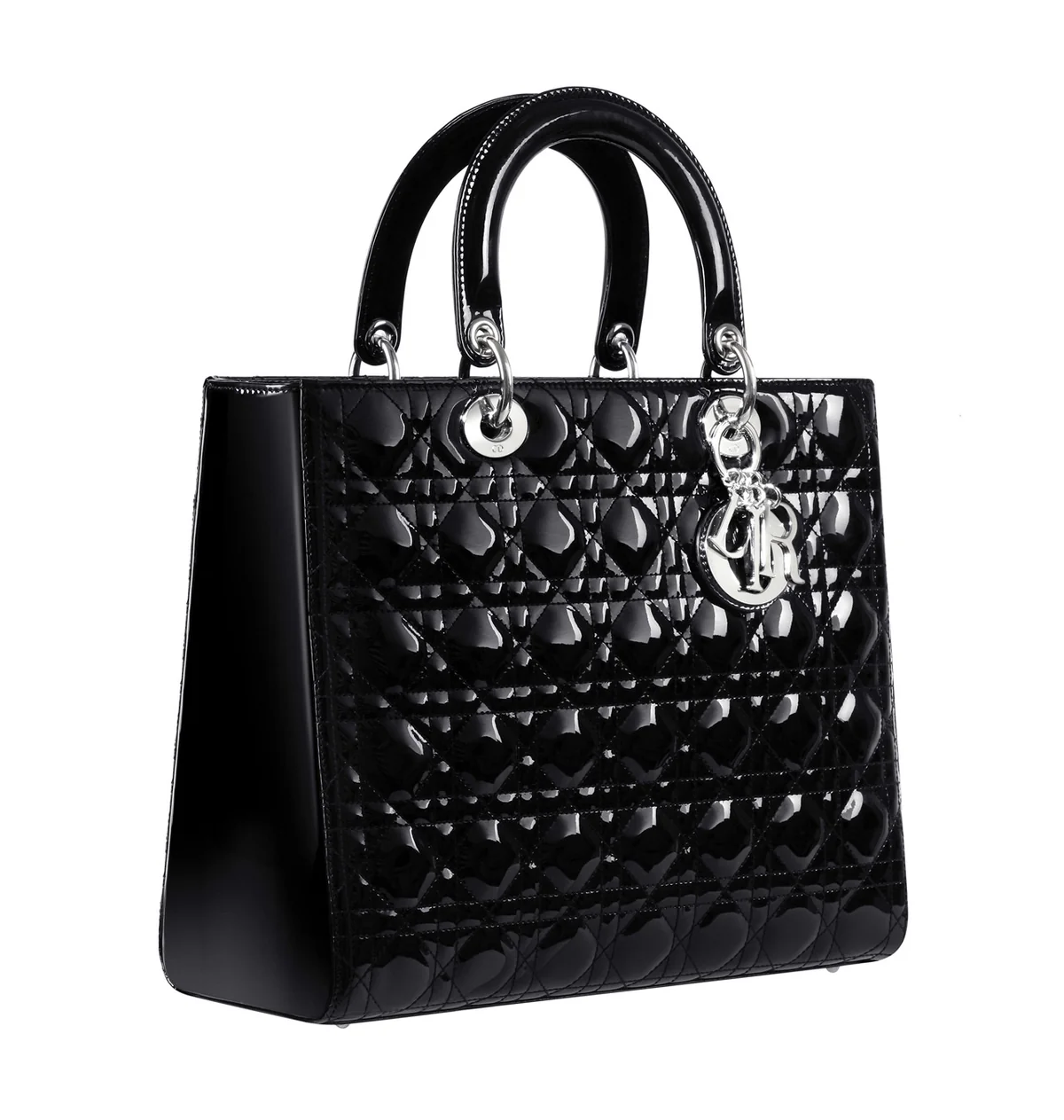
Stitching and quilting. The cannage diamond quilting on a Lady Dior should be symmetrical across both bag panels — if the diamonds drift or don’t line up at the seams, walk away. Stitch length should be uniform, with no visible glue seepage at the edges.
Leather and smell. Dior uses lambskin, calfskin, and patent leather across the Lady Dior range; each has a distinct grain and scent. A chemical or plastic smell is a red flag on anything sold as leather.
Interior markings. Dior has shifted its internal authentication markings over the years, moving away from the older printed date-code format toward newer security features on more recent production. Ask sellers for clear photos of interior stamps, any accompanying authenticity cards, and original receipts where possible — and don’t take a seller’s word over documentation.
Price sanity check. If a “barely used” Saddle bag is priced 40% below every comparable listing, that’s not a deal, it’s a warning sign.
For anything above a few hundred dollars, it’s worth paying for a third-party authentication service on top of buying from a reputable resale platform — the fee is small compared to the cost of an outright fake. And be honest with yourself about condition: vintage Dior, especially pieces from the Galliano era, often comes with wear that photos don’t fully capture, so ask for close-ups of corners, handles, and interior lining before committing.
Frequently Asked Questions #
Is Dior a good resale investment compared to Chanel? Chanel’s Classic Flap generally holds value better and more consistently than most Dior handbags, partly due to Chanel’s steady price increases. The Lady Dior and Saddle bag hold value reasonably well, but expect more fluctuation tied to trend cycles and which creative director’s era a piece is from.
Why did Dior stop using printed serial numbers? Like several luxury houses, Dior has adjusted its internal tracking and security markings over time to combat counterfeiting, which means authentication now relies more heavily on craftsmanship details and documentation than on a single serial code.
Are older Galliano-era Dior pieces worth collecting? Often yes, especially early Saddle bags and pieces referencing Dior’s historical archive, but check condition carefully since these pieces are now 15–25 years old.
Signature Design Elements That Define Dior’s Identity #
Strip away the seasonal collections and a handful of design signatures explain why a Dior piece reads as Dior from across a room:
Cannage stitching — the diamond-quilted pattern lifted directly from the Napoleon III chairs in Dior’s original Avenue Montaigne salon. It first appeared on bags in the 1990s and is now inseparable from the Lady Dior’s identity.
Toile de Jouy — the 18th-century French pastoral print, revived heavily under Chiuri on the Book Tote and ready-to-wear. It’s a deliberate callback to French decorative heritage rather than a house-original pattern.
The Bar Jacket silhouette — the fitted waist and rounded peplum hip from 1947 still surface in collections today, sometimes literally, sometimes as a structural reference in a blazer or coat.
Trianon gray and gold hardware — the pale gray associated with Dior boutiques and packaging, paired consistently with warm gold-tone metal, giving even a small accessory an immediately identifiable finish.
These recurring elements are why Dior pieces from wildly different decades and designers still look like they belong to the same family — a design continuity that’s harder to maintain than it looks, and one Chanel and Saint Laurent manage in their own, very different ways through the quilted flap and the YSL cassandre logo respectively.
Iconic Products: From the Bar Jacket to the Lady Dior Bag #
The Bar Jacket #
The garment that started it all in 1947. Structured through the bust, nipped at the waist, flared at the hip — it’s less a jacket than a piece of architecture, and it remains the reference point every subsequent Dior creative director has had to either honor or push against.
The Lady Dior Bag #
Launched in 1994 as “Chouchou,” renamed after Princess Diana’s public devotion to it, the Lady Dior is built around cannage quilting and the swinging D-I-O-R charms. Current retail for a small Lady Dior in lambskin runs roughly in the $4,700–$5,300 range depending on size and hardware, with exotic skins and limited editions running considerably higher. On the resale market, well-maintained examples in classic black or neutral tones tend to hold value more reliably than seasonal color or embellished versions.
The Dior Saddle Bag #
John Galliano’s 1999 design, instantly recognizable by its asymmetric flap shaped like an actual saddle. It fell out of favor for years before Maria Grazia Chiuri revived it in 2018, reintroducing it in the house’s oblique monogram canvas alongside classic leather. New retail typically sits between $3,600–$4,200 for the standard size. It’s a bag that photographs distinctly, which helps resale demand but also makes poor counterfeits easier to spot with a trained eye — the saddle shape itself is hard to fake convincingly.
J’adore #
Launched in 1999 and created by perfumer Calice Becker, J’adore built its identity around a gold, sculptural bottle and a scent profile centered on ylang-ylang, damask rose, and jasmine. It sits in fragrance alongside Chanel No. 5 and Saint Laurent’s Black Opium as one of the handful of scents that functions as a category benchmark rather than just another release — a reminder that Dior’s influence extends well past handbags and couture into how an entire fragrance segment is built and marketed.
Across all three categories — ready-to-wear, leather goods, and fragrance — the throughline is the same: Dior’s most enduring products are the ones that solved a specific design problem (a silhouette, a bag shape, a scent structure) so thoroughly that competitors have been answering to them for decades. That’s the real case for what makes Dior special, and it’s also exactly why buying one, new or pre-owned, rewards the kind of care outlined above.
Related Articles #
- 5 Iconic Bags Named After Famous Women (Buying Guide)
- Lady Dior Bag: The Story Behind Princess Diana’s Icon
- Saint Laurent Kate Bag Review: Style, Fit & Resale Value
- Dior Granville Bag Review: Honest Take After Years
- How Pre-Owned Luxury Fashion Is Reshaping the Industry
Related guides
- Online Bag Authentication: What Photos Can and Cannot Prove
- Inside a Million-Dollar Closet: Pre-Loved Hermès & More
- Meet Marwa Azzam Aldabbagh: Kelly Bag Authentication Expert
- Luxury Handbag Authentication Process Explained
- How to Buy an Authentic Luxury Bag from China Safely
- New vs Pre-Owned Luxury Bags: Which Route Is Right for You?
- Chanel Bag Guide: What to Know Before You Buy
- Luxury Bag Houses


Keyword index